Notes for the comparative advantage section. This forms part of 4.2.6.2 Trade in the AQA Economics A Level specification.
Contents
The distinction between absolute advantage and comparative advantage
Absolute advantage
Absolute advantage occurs when one country can produce a good more cheaply (or with higher productivity) relative to another country.
In other words, suppose two countries A and B have the same number of workers say a million workers.
In country A those one million workers can produce three million cars a year. But in country B, one million workers can only produce two million cars a year.
In that case country A has the ‘absolute advantage.’
Adam Smith wrote about this idea first in 1776 in his famous “Wealth of Nations” work.
One issue is there will be some countries without any absolute advantages.
In that case, what is the implication of Smith’s absolute advantage?
That these countries should not produce anything does not sound satisfactory – surely their production could be useful to someone?
Enter David Ricardo who came up with the “comparative advantage idea”…
Comparative Advantage
What does comparative advantage mean?
A country has a comparative advantage in a particular good when that country can produce a good with a lower opportunity cost relative to another country
The textbook definition of opportunity cost is “the next best alternative foregone when an economic decision is made”.
When it comes to trade, consider an economy that only produces two goods – say apples and oranges. How many oranges need to be given up to produce one more apple? The oranges are what we give up or forgo to produce the apples.
Ricardo’s comparative advantage theory was that if a country has a comparative advantage in a good, they should specialise in producing that same good.
Let us use a diagram to illustrate this theory.
PPF Diagram – the model of comparative advantage
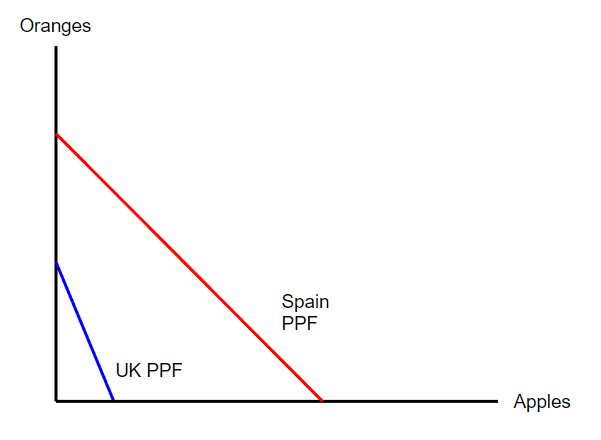
This diagram shows the production possibility frontiers for two countries, UK and Spain. They can use one factor of production e.g. labour to produce two different goods, say oranges and apples. Each country can produce lots of oranges and no apples, only apples and no oranges, or somewhere in between.
To produce one (more) Apple, the UK has to give up more oranges compared to Spain. We can tell this from the diagram. In particular note the UK has a steeper PPF than Spain – for a given number of apples, the UK gives up more oranges.
So we could say the UK has a comparative advantage in oranges and Spain has a comparative advantage in Apples.
[Note the example above is fictional. The UK’s actual comparative advantages are different and are mentioned later on in the article.]
Under the theory of comparative advantage, this means the UK should specialise in oranges and Spain in apples.
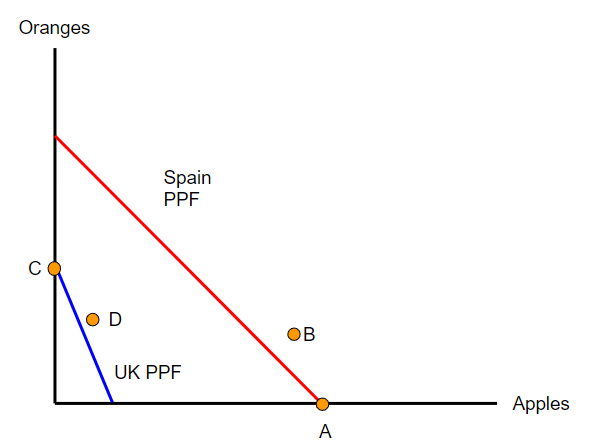
In the next diagram, that means the UK producing at point C on its PPF while Spain produces at point A.
“Gains from trade”
Why is it beneficial for countries to specialise according to their comparative advantages? Under the theory, there are “gains from trade”.
We can use the diagram above to show this. Remember Spain is initially producing at point A and the UK at point C.
Spain and the UK could then agree to trade some of the UK’s oranges for some of Spain’s apples. They could trade at a mutually beneficial rate, allowing both countries to move beyond their domestic PPFs. For example, Spain could move from point A to B and the UK could move from C to D (not to scale).
The gains from trade are the ability to move beyond your domestic PPF.
It is more efficient for Spain to A) produce apples themselves and then trade with the UK for oranges than B) for Spain to produce oranges themselves.
Note that comparative and absolute advantages do not need to align. In this example above for example, Spain has absolute advantages in both apples and oranges.
Table example – model of comparative advantage
The table shows the same example but in numerical form.
Let’s assume the countries UK and Spain have the same size workforce.
The table shows the value of production, for apples and oranges, if that country put all labour force towards that good. Let the amounts be valued in billions of pounds (£bn).
So the UK could produce either £0.5bn of apples if it produced solely apples. Alternatively the UK could produce £1bn of oranges if it produced only oranges.
The final two columns show the opportunity costs (“opp. costs”) for each good. To produce one unit (in this case £1bn) of apples, the UK needs to give up half a unit (£0.5bn) worth of apples.
| Apples | Oranges | Opp. cost of apples | Opp. cost of oranges | |
| UK | 0.5 | 1 | 0.5/1 = 0.5 | 1/0.5 = 2 |
| Spain | 2 | 2 | 2/2 = 1 | 2/2 = 1 |
[Note Spain has absolute advantage in both goods.]
Under the theory of comparative advantage, Spain has the lower opportunity cost in oranges compared to the UK (1 is less than 2), so Spain should specialise in oranges.
Yet the UK has a comparative advantage in apples (0.5 is less than 1) so the UK should specialise in apples.
The logic and results are exactly the same as those for the graph mentioned earlier.
Limitations of comparative advantage
The limitations of the theory of comparative advantage include:
- Comparative advantage implies that countries should specialise in goods according to their comparative advantage. However specialisation exposes the economy to the risk that demand for the specialised good will suddenly drop. This would cause a significant fall in workers’ wages and the real GDP.
- Assumes only two countries and two goods. In the real world there are many different goods being traded and by many different countries..
- No tariffs/protectionism. If there are protectionist measures in place, there may not be gains from trade.
- Assumes no transport costs. Particularly for island or geographically isolated economies, transport costs may be significant.
- Assumes perfect factor (e.g. labour) mobility between sectors. In practice there is likely to be diminishing marginal returns to moving labour into a new sector. Workers cannot easily move to a new sector to exploit comparative advantage – this is likely to lead to structural unemployment.
- Assumes the countries are willing to trade but in practice poor international relations may stop this.
For more on tariffs and protectionism, see the link below:
Other issues with Comparative Advantage
One key point is that comparative advantages are dynamic and not static. In other words, a country’s comparative advantage may change over time.
Related to this, there is the “infant industry” argument. That is the productivity in an industry may depend on the size of the firm(s) in that industry.
Indeed there may significant “economies of scale” – growth of firms in that industry may increase productivity, reducing average costs and opportunity costs.
Comparative advantage is an argument that economists have used to promote free trade.
Critically though, comparative advantage ignores distribution. Even if there are “gains from trade”, who receives these gains?
There are several other explanations for trade patterns. These include, for example:
- “Gravity” – countries trade more with countries in closer proximity, just like how closer planetary objects exert greater gravitational pulls on one another.
- Historical or current political/economic ties. For example being members of the same trading bloc or a former colony of an old empire.
- Current factor endowments (see the “Heckscher-Ohlin” model beyond the A-level course).
- Other ideas including increasing returns to scale.
The UK example
What are examples of comparative advantage for the UK?
Based on the measure of “revealed comparative advantage”, the UK has a comparative advantage in the following sectors:
- Financial and insurance activities
- Arts, entertainment, recreation and other service activities
- Publishing and broadcasting
- Education
- Telecommunications
Other examples could include:
- Countries with beautiful natural environments having a comparative advantage for tourism. Think of Mount Everest for example.
- Countries with the correct climate for various crops. Oranges in Spain for example (the famous “Seville” oranges).
Other Resources
For A-level Economics resources, click the link here:
About the author
